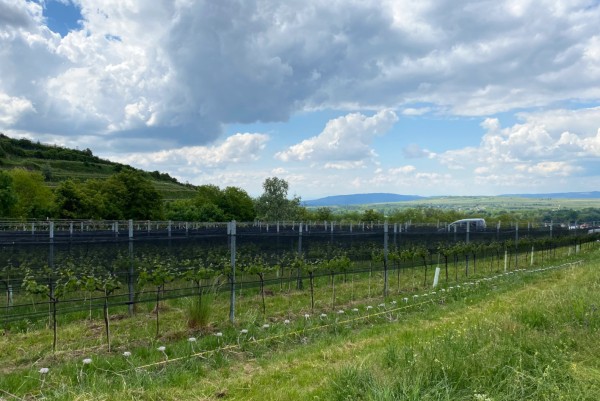
The open-air site of Kammern–Grubgraben, discovered in 1870, is one of the rare locations where life during the final phase of the last Ice Age can be studied. Throughout the 20th century, the site was repeatedly investigated, with systematic excavations beginning in 1985 and continuing in the 1990s.
Renewed fieldwork in 2014–2016 identified two Palaeolithic occupation layers and revealed numerous artefacts as well as a stone pavement. New radiocarbon dates confirmed the site’s attribution to the Last Glacial Maximum (around 19,000 BP). Ongoing research continues to refine understanding of this key Upper Paleolithic settlement.
In spring 2021 we carried out geoelectrical investigations at the site. The survey aimed to locate stone features at depths between 1.5 and 4 m, previously documented in archaeological excavations. Covering an area of approximately 540 m², the measurements helped to map buried stone structures made from local sedimentary rocks of the Zöbing Formation.